Canada has several hundred companies that make or sell store fixtures, but they are not interchangeable. A grocery chain buying gondola shelving, a fashion brand building a flagship, a cannabis retailer opening twenty stores and a pharmacy refitting its dispensary are each buying from a different part of the industry. This guide explains how the Canadian store fixture industry is organized, what each type of supplier does well, and how to match the supplier to the project.
Where the industry is
Canadian fixture manufacturing is concentrated in two regions. The Greater Toronto Area, including Vaughan, Mississauga, Brampton and Markham, has the largest concentration, followed by the Montreal area. Smaller clusters serve Western Canada from Alberta and British Columbia. RevenueBase’s October 2026 company data, for example, lists Toronto, Montreal and Mississauga as the three cities with the most commercial fixture manufacturers. For a national retailer, that means much of the custom fixture work for Canadian stores is built in Ontario or Quebec and shipped across the country.
The five kinds of fixture supplier
1. System and shelving manufacturers
These companies make standardized metal shelving, gondolas, checkouts and wire systems in high volumes, often to their own catalogue. Grocery, pharmacy, convenience and hardware chains rely on them because the systems are modular, replaceable and consistent from store to store. Some Canadian companies are both manufacturers and authorized distributors for large US shelving brands. They are the right choice when the store is built around a planogram and the fixtures need to be reconfigured often. They are usually not the right choice for one-off branded millwork.
2. Custom millwork and fixture manufacturers
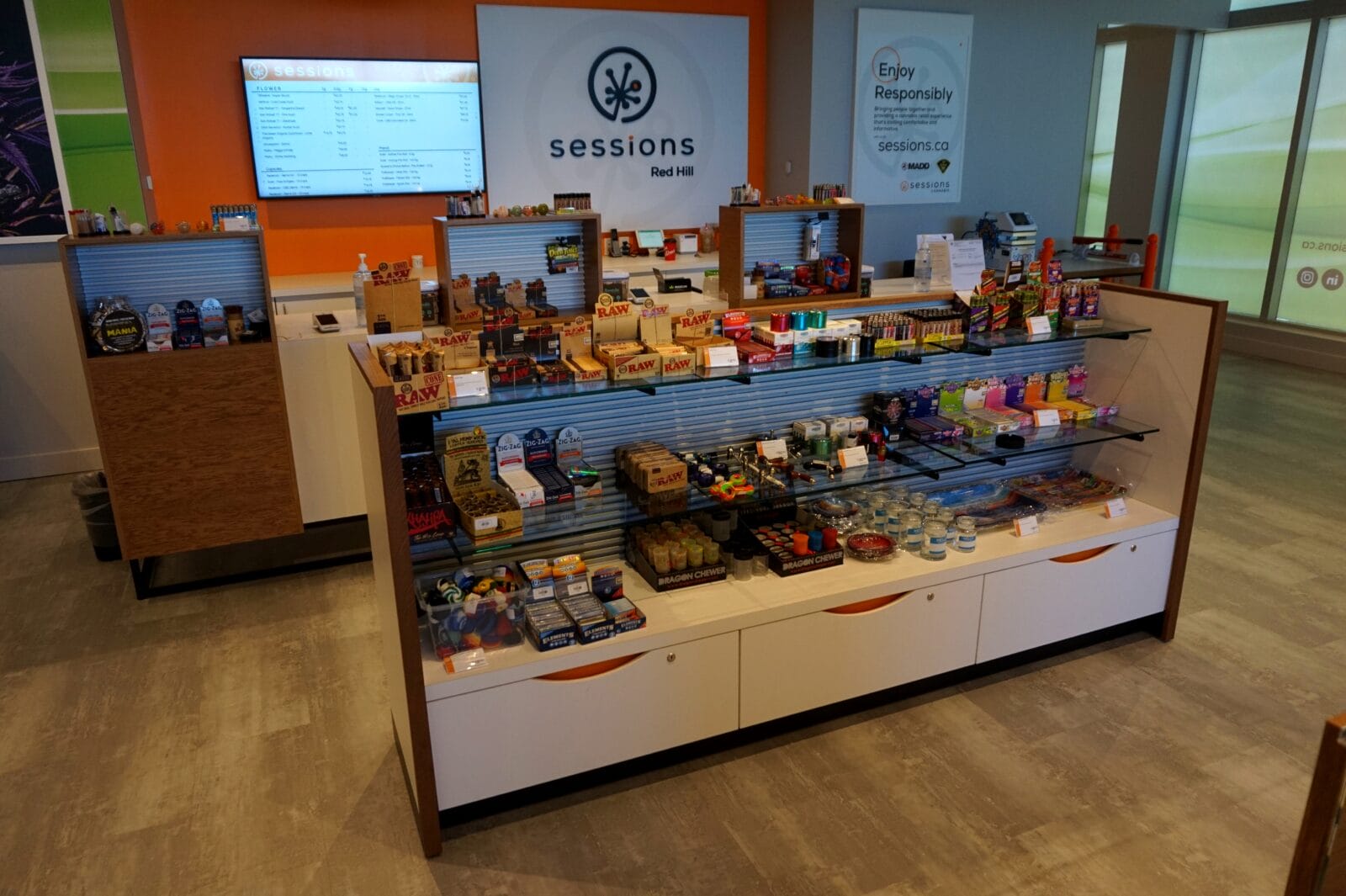
These shops build fixtures to a brand’s or designer’s drawings: cash wraps, display cases, wall systems, feature walls, tables and counters, usually in wood, laminate, veneer, solid surface and acrylic, with metal, glass and stone either produced in house or sourced through specialist partners, depending on the manufacturer. They produce shop drawings, fabricate, finish and stage the fixtures, and many run multi-store rollout programs. This is the right type of supplier for brand-led stores, flagships, shop-in-shops, cannabis retail, food service and clinics, where the fixture is part of the design.
3. Point-of-purchase (POP) and display specialists
POP companies design and produce displays that sit in someone else’s store: countertop displays, floor stands, endcaps, shipper displays and brand programs placed in grocery, pharmacy and big-box retailers. Many work in corrugated board, plastics, wire and printed graphics, and they are organized around high quantities, short campaigns and shipping to hundreds of locations. A brand placing product in retailers usually buys from a POP specialist; a retailer fitting out its own store usually does not.
4. Distributors and stock fixture suppliers
Distributors sell catalogue fixtures, showcases, slatwall, racks, mannequins and store supplies, often from inventory. They are fast and economical for independent stores, pop-ups and replacements, and some offer light customization. They do not usually produce shop drawings or build to a designer’s details.
5. Design-build and program management firms
Some companies manage the whole store program: design, sourcing from several manufacturers, logistics and installation. They suit retailers without an internal store-planning team. The fixtures themselves may be built by any of the manufacturers above, so it is worth asking who makes them.
Domestic, US or offshore sourcing
Canadian retailers can source fixtures in Canada, in the United States or offshore, most often from Asia. Offshore production can lower the unit price on large, repeatable quantities, but it adds ocean freight time, duties, less control over finish and fewer chances to fix problems before the store opens. Domestic production makes it easier to visit the shop, approve samples and mock-ups in person, resolve changes faster, and replace a damaged piece sooner. For multi-store programs, many retailers use domestic manufacturers for the brand-critical fixtures and source standard components wherever the price is best.
Cross-border shipping also changes the comparison. Duties and tariffs on fixtures moving between Canada and the United States have changed more than once since 2025, so check the current rules for the specific product and route with a customs broker before comparing quotes.
Canadian rules that shape fixtures
Whatever the supplier type, some requirements are specific to Canada or to individual provinces and should be in the specification:
- Accessible service counters. In Ontario, new and replacement service counters fall under the Design of Public Spaces Standards. See our cash wrap guide.
- Electrical approval. Lit fixtures are electrical equipment, and provinces require electrical products to be approved before they are connected. Agree early who supplies, approves and connects the lighting.
- Sector regulators. Pharmacies, alcohol sales and cannabis retail each have provincial requirements that affect the fixtures, from dispensary layouts to after-hours locking. See our guides to pharmacy millwork, beer and wine fixtures and cannabis dispensary fixtures.
- Bilingual graphics. In Quebec, French-language requirements apply to signage and product information, which affects graphic panels and sign holders.
How to choose the right type of supplier
- Start from the fixture, not the vendor. Modular shelving, custom millwork, in-store POP and stock fixtures come from different parts of the industry. Many stores need more than one.
- Check who actually builds it. Ask which work is done in the supplier’s own plant and which is sourced from partners. Both models can work; what matters is that one party is accountable.
- Look at comparable work. A shop that builds clinics may not suit a luxury flagship, and a high-volume shelving plant may not suit a ten-store rollout of custom pieces.
- Ask about drawings and approvals. Custom work should come with shop drawings for review, and for rollouts a sample or first-store approval before full production.
- Plan the schedule backwards from opening. Lead times are project dependent; give the supplier your opening date and drawings early.
Our article on how to choose a store fixture manufacturer goes through the qualification questions in more detail, and types of retail store fixtures explains the main fixture families.
Where DNS fits
DNS Industries is a custom millwork and store fixture manufacturer in Vaughan, Ontario, operating since 2001. Our drafting team produces shop drawings, and we do CNC machining, solid surface and acrylic fabrication, finishing and staging in our own plant, with metal, glass and stone from specialist partners we coordinate. Most of our work is brand-led retail and multi-store rollouts across Canada and the United States, along with healthcare and commercial interiors.
Frequently asked questions
Where are most store fixture manufacturers in Canada?
Mostly in the Greater Toronto Area and the Montreal area, with smaller clusters in Alberta and British Columbia.
What is the difference between a store fixture manufacturer and a POP display company?
A store fixture manufacturer builds the permanent fixtures a retailer uses to fit out its own store. A POP company makes displays that brands place in other retailers’ stores, usually in higher quantities and for shorter campaigns.
Should I buy store fixtures in Canada or offshore?
Offshore production can be cheaper for large repeatable quantities, while domestic production gives faster changes, in-person approvals and quicker replacements. Many retailers use domestic manufacturers for brand-critical fixtures and source standard components wherever the price is best.
Can one company supply all the fixtures for a store?
Sometimes, but many stores combine a custom millwork manufacturer for counters, cases and feature walls with a shelving manufacturer or distributor for standard systems.
Related guides: Hybrid fixture programs: offshore volume, local customization.