
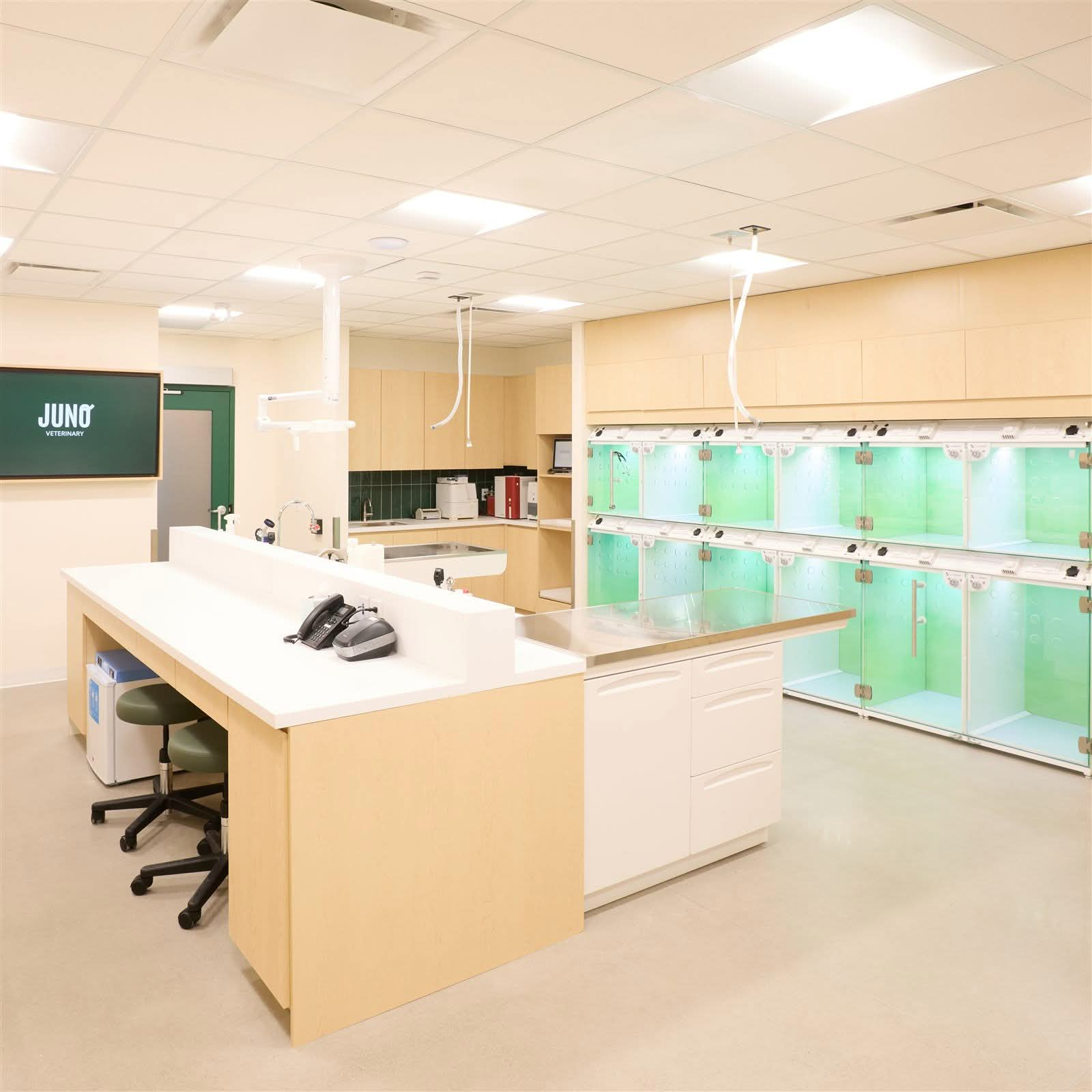
Veterinary clinic millwork takes harder use than most commercial casework: frequent wet cleaning, strong disinfectants, animals that scratch and chew, and heavy equipment on the counters. How hard varies by room and by the clinic’s own protocol. This article covers what to specify for the reception, exam rooms, treatment and lab areas so the millwork stands up to that use.
Start with the cleaning protocol
Before choosing finishes, get the clinic’s cleaning products and schedule in writing. Veterinary practices commonly use accelerated hydrogen peroxide or quaternary ammonium disinfectants, and some use bleach solutions in isolation and kennel areas. Each affects finishes differently, and concentration, contact time and whether the surface is rinsed all matter. Laminate and solid surface manufacturers publish chemical-resistance data for their products, so the specification should name the products, concentrations and contact times the clinic will use, and the designer and fabricator can then check the finishes against that data. This one step heads off many of the finish problems that otherwise show up a year after opening.
Materials that hold up
- Work surfaces: solid surface is the usual choice for exam and treatment counters because it has very low porosity, the seams can be sanded flush, sinks can be bonded in with a smooth transition instead of an exposed joint, and scratches can be refinished. Quartz is harder and suits counters that take heavy wear, but it cannot give the seamless look or integral sink that solid surface can, and its edges and cut-outs can chip under impact. High-pressure laminate (HPL) is acceptable for reception and office desks that are cleaned less aggressively.
- Cabinet faces and sides: HPL on fronts that take heavy use, thermally fused laminate (TFL) where exposure is lighter, both on a moisture-resistant core with sealed edges and penetrations. A moisture-resistant core slows water damage; it does not make the cabinet waterproof. Choose matte or lightly textured finishes; high gloss shows every scratch and cleaning streak.
- Edges: 2 mm or thicker PVC or ABS edgebanding on exposed door, drawer and case edges, including the ones behind doors, with the treatment of concealed and wet-area edges shown on the drawings. Thin edge tape lifts after repeated wet cleaning. Solid surface edges can be rounded and are the most durable option on counters.
- Cores: moisture-resistant MDF or particleboard in dry locations. Wood-based cores swell when they are hosed or left wet, so under sinks, in bathing areas and at the base of any cabinet on a floor that gets hosed, specify a water-resistant substrate such as closed-cell PVC board, HDPE or solid phenolic core instead. These three are not interchangeable: they differ in stiffness, screw holding, movement and bonding, so the fabricator details each one differently.
- Hardware: pulls with a corrosion-resistant base material and a finish the hardware maker rates for the clinic’s cleaners, soft-close hinges rated for commercial use, and full-extension drawer slides with a load rating that matches what the clinic will store in the drawer, not the catalogue default.
Details that matter in a clinic
- Coved and sealed junctions: on solid surface counters, a thermoformed cove between the counter and the backsplash; on laminate or quartz, a continuous sealed joint, because those materials cannot be coved. Where the floor has an integral cove base, run the toe kick down to the floor so the sheet flooring and its cove can continue up the face of the kick with no ledge to trap hair and fluids, and coordinate the kick substrate, cove height and installation sequence with the flooring contractor.
- Raised kicks or legs: in wet areas, cabinets on stainless legs or a raised, sealed kick keep the core off the floor and let the floor be cleaned underneath.
- Corners: rounded outside corners on counters and end panels in exam rooms and treatment, where animals and staff move quickly in a small space.
- Scratch and chew resistance: in kennel and waiting areas, protect the lower part of exposed cabinet faces, typically the bottom 300 mm, with a replaceable stainless or solid-surface kick plate, with the height and corner treatment agreed with the designer.
- Sinks: deep, undermount or integral bowls with the faucet reach checked against the bowl, and a gooseneck or wrist-blade tap if the clinic asks for hands-free use.
- Power and data: outlets set above counter height for monitors, scales and clippers, with the cabinet backs cut and grommeted so cords do not run across the work surface.
- Controlled substances: these need secure, fixed storage, usually a locked metal cabinet or safe anchored to the structure. The College of Veterinarians of Ontario and federal regulations set the requirements, so confirm them with the practice owner before the cabinet is drawn.
Reception and the waiting area
The reception desk has to carry the clinic’s brand and still be easy to clean. It usually combines a wood-look laminate or veneer on the public face with a solid-surface transaction top and a cleanable, durable work surface on the staff side. Plan for two or three staff stations, a lowered accessible section, cable management for terminals and card readers, and a kick or toe area that can take a dog lead and a wet floor. Separate check-in and check-out points, or a split between cat and dog waiting sides, are design decisions that should be settled before the desk is drawn.
Exam rooms
A typical exam room has a wall-hung or floor-standing counter with a sink, upper cabinets, and a bench or window seat for clients. Keep the counter depth consistent so lift tables and scales fit, and specify a removable panel or access door wherever plumbing or a drain line sits behind the millwork. Clients spend time in these rooms, so the finish on the public face can be warmer than the treatment area, as long as it meets the cleaning requirement.
Treatment, lab and pharmacy
Specify continuous solid-surface counters with integral sinks and coved backsplashes, open shelving or glass-front uppers where staff need to see supplies, and tall storage with adjustable shelves. In the lab, allow for equipment weights and vibration, and keep a clear zone around centrifuges and analysers. In the pharmacy, lockable cabinets and drawers with dividers are standard.
Code, accessibility and standards
Veterinary clinics in Ontario fall under the Ontario Building Code, and service counters and other public areas have to meet the barrier-free requirements of Section 3.8 and the AODA Design of Public Spaces standard where they apply. The architect or designer confirms the occupancy classification and which requirements apply. Where a specification references AWI or NAAWS quality grades, Custom grade is the normal choice for clinic casework, with Premium reserved for feature pieces. The grade alone does not require moisture-resistant cores or heavy edgebanding, so the specification has to call those out for the wet areas. See AWI quality grades explained and millwork code compliance.
Multi-location practices
Veterinary groups opening several clinics benefit from the same approach as retail rollouts: one approved set of casework details, a control sample for each finish, and store-by-store releases. The first clinic carries the drafting; the next ones usually go faster and more consistently. See rollout programs.
How DNS builds veterinary millwork
DNS drafts, machines, finishes and assembles clinic casework and reception desks in Vaughan, Ontario, with solid surface fabricated in-house and stone, glass, metal and, on some projects, installation handled by specialist partners. We work from the designer’s drawings and the clinic’s cleaning requirements, and we issue shop drawings for review before production. DNS has supplied millwork for several Juno Veterinary clinics in the Toronto area, including 980 Queen Street East: see the Juno Veterinary case study and our healthcare, medical and veterinary millwork page.
Frequently asked questions
What is the best countertop for a veterinary clinic?
Solid surface for exam, treatment and lab counters, because it has very low porosity, can be seamed flush, takes an integral sink and can be refinished. Quartz for counters that take heavy wear, accepting visible seams and a separate sink. Confirm the finish against the clinic’s disinfectants.
Can veterinary millwork use laminate?
Yes, on cabinet faces and reception desks, with a moisture-resistant core and thick edgebanding. Check the laminate’s chemical-resistance data against the clinic’s cleaning products.
How is veterinary casework different from dental or medical casework?
The cleaning products are stronger, the animals scratch and chew, and the floors are often hosed, so clinic millwork needs more edge protection, raised or sealed kicks and better moisture resistance at the base of every cabinet.