
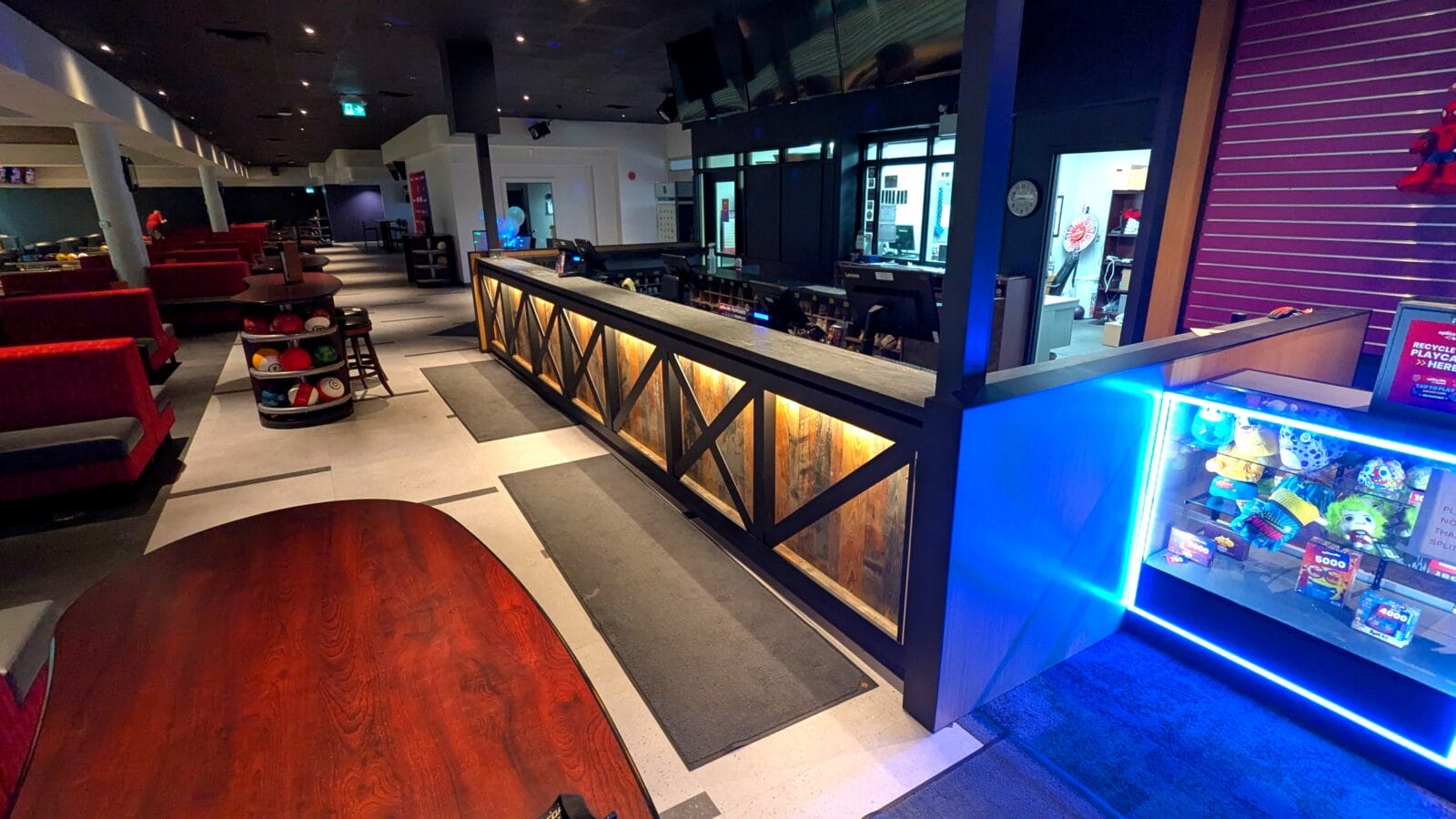
A bowling and entertainment venue is four buildings pretending to be one. There is a bar with a full back-of-house behind it, a retail prize shop, a food service counter, and several thousand square feet of public floor that families walk across in socks. Each of those has a different millwork brief, a different cleaning regime and a different failure mode — and they all sit in the same room, under the same brand standard.
DNS Industries value-engineered and fabricated the fixture packages for seven Splitsville venues: Kanata, Woodbridge, Burlington, Hamilton and Guelph in Ontario, and Highfield and Creekside in Calgary. DNS installed the five Ontario venues; Monument Developments installed the two Alberta venues.
Value engineering was the actual scope
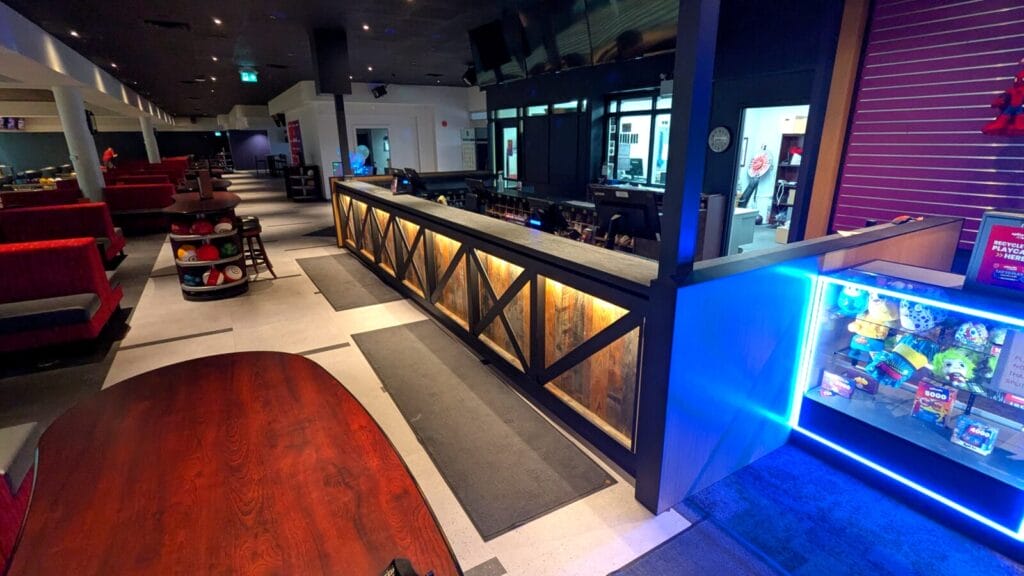
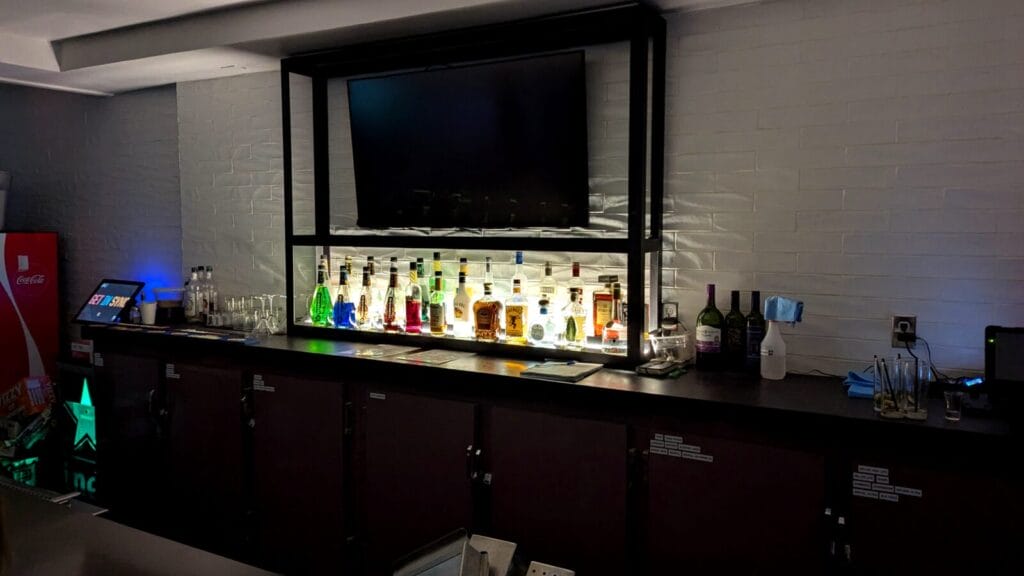
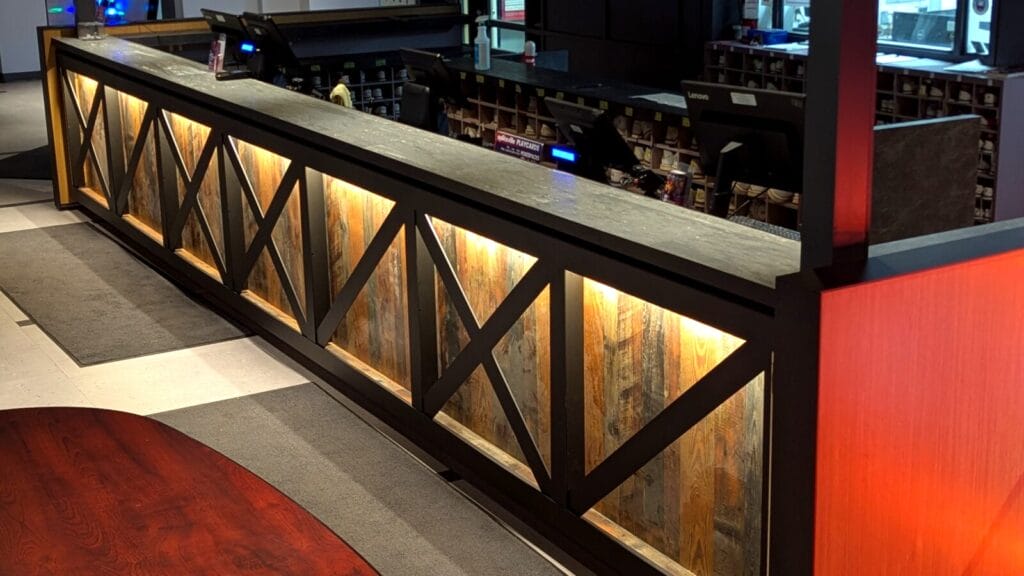
DNS did not design these venues. The design intent arrived already resolved — reclaimed-wood panels in blackened steel frames, backlit bottle displays, stone-look counters running the length of the lane approach. Our job was to make that intent buildable at a number that could be repeated seven times without the seventh venue looking cheaper than the first.
That is what value engineering actually is, and it is routinely misunderstood as cost-cutting. It is not. It is finding the construction method that preserves the visible result while changing what sits behind it: substrate choices the customer never sees, panel sizes that stop wasting a sheet, connection details that let a crew of two set a run instead of a crew of four. The look survives. The cost does not. We wrote a longer explanation of where those savings actually hide in value engineering in millwork.
On a single venue, VE saves a line item. Across seven, it compounds — which is the entire reason to engage a manufacturer at the estimate stage rather than after the drawings are stamped.
What the environment does to millwork
Entertainment venues punish fixtures in ways retail does not, because nobody in the building is being careful.
- Impact, constantly. Bowling balls are dense, dropped, and rolled into things. Counter fronts, toe kicks and any exposed corner take repeated hits from objects specifically designed to be heavy.
- Spills as a baseline condition. Full bar service on a carpeted public floor means liquid reaches the bottom of every cabinet. Toe kick detailing and substrate selection at floor level are lifespan decisions, not finish decisions.
- Late hours, seven days. These venues run long and clean fast. Surfaces get wiped hard, quickly, with whatever is to hand.
- Children at hand height. Everything below about 1200 mm is touched, leaned on and climbed by people who do not read signage.
The details that had to repeat exactly
A brand standard lives or dies in a small number of signature pieces, and those are the ones that have to be identical across every location.
The X-panel is the piece a customer photographs. It is also the hardest to standardise, because reclaimed timber is not a consistent material: colour, width and wear vary between boards and between deliveries. Producing seven venues that read as the same brand means controlling that variation at the layout table, not hoping it averages out.
The unglamorous half
Most of a venue package is not the feature wall. It is service casework that has to absorb constant use and stay serviceable, and it is where a fixture program quietly succeeds or fails.
Several of these venues were renovations inside operating buildings, which means the structure was already there and rarely where the drawings put it. Casework that has to fit around a column, a drain or a floor that is out of level gets resolved on site — and it gets resolved faster when the people installing it are the people who made it.
Why the install scope matters
DNS installed the five Ontario venues; in Alberta, Monument Developments installed the packages DNS built and shipped. Installation scope varies by project, and where DNS installs, it changes how problems get solved.
When fabrication and installation sit with two companies, a fit problem becomes a conversation about whose tolerance was wrong. When they sit with one, it becomes a measurement and a modification. On a venue opening to a public date, that difference is measured in days.
On the Ontario venues it also meant one accountable party for the whole fixture scope: shop drawings, drafting, fabrication, finishing, delivery and setting. For a general contractor coordinating a venue fit-out, that is one fewer interface to manage on the critical path.
From one venue to a program
The first Splitsville venue is where the standard got set. Every venue after it drew on documented details, known material sources and a fixture list that had already been proven on a floor rather than on a drawing.
That is the same production discipline we apply to national retail rollouts — more than 60 L’Occitane stores as millwork supplier of record for North America, and fixture packages for more than 350 cannabis retail locations. Entertainment venues are larger and rougher than a mall store, but the problem is identical: reproduce a standard, in buildings that differ, to dates that were sold to the public.
Frequently asked questions
What was DNS Industries’ scope on the Splitsville venues?
Value engineering and fabrication of the fixture and millwork packages for all seven venues, and installation of the five Ontario venues; Monument Developments installed the two Alberta venues. DNS did not design the venues; the design intent was provided, and DNS made it buildable and repeatable at a cost that worked across the program.
Which Splitsville locations did DNS build?
Kanata, Highfield, Woodbridge, Burlington, Hamilton, Guelph and Creekside.
What millwork does an entertainment venue need?
Host and check-in desks, full bar and bar-back assemblies, food service counters, retail and prize-shop casework, ball and shoe storage, feature walls, and lane-side service millwork. Most of it is high-contact, high-impact and wet at floor level.
Can DNS handle fixture programs across multiple venues?
Yes. Multi-location production is the core of the business rather than an adjacent service. DNS is the millwork supplier of record for L Occitane in North America with more than 60 stores built, and has manufactured fixture packages for more than 350 cannabis retail locations.
Planning a venue or a multi-site program? Send us your drawings and we will tell you what is buildable, what it costs and how long it takes.
Related guides: Entertainment venue millwork.